
If you’ve spent any time shopping for a new TV or monitor lately, you’ve likely stumbled upon a confusing alphabet soup of specs. Beyond the resolution (4K, 8K) and the backlight technology (OLED, Mini-LED, QLED), there is a fundamental hardware choice that dictates almost everything you see on screen: The Panel Type.
In the world of LCD-based displays, two titans rule the market: VA (Vertical Alignment) and IPS (In-Plane Switching).
Does it matter? Absolutely.
Choosing the wrong one for your specific room could mean the difference between a cinematic masterpiece and a washed-out mess. Let’s dive into the liquid crystal physics and find out which one belongs in your home.
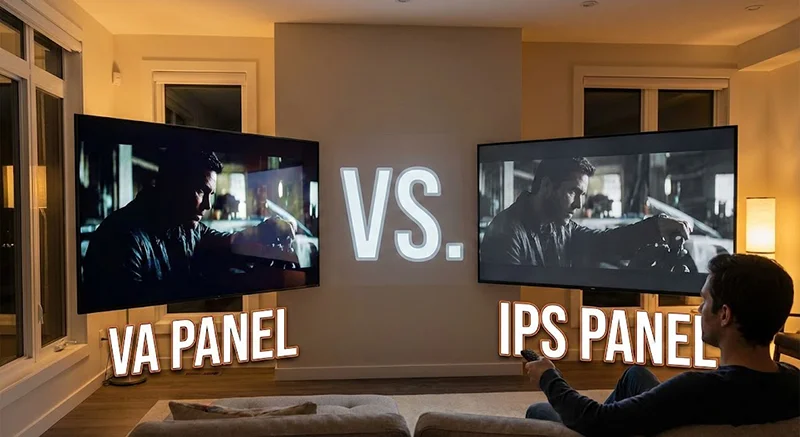
The Fundamentals: How They Work
To understand the difference, you have to understand how an LCD works. Think of the panel as a series of tiny "shutters" (liquid crystals) that open and close to let light from the backlight through.
- VA (Vertical Alignment): As the name suggests, the crystals in a VA panel are aligned vertically (up and down) when the pixel is "off." When electricity is applied, they tilt to let light through. Because they are so tightly packed in a vertical line, they are excellent at blocking light when they are supposed to be closed.
- IPS (In-Plane Switching): These crystals stay parallel to the glass at all times. Instead of tilting up and down, they rotate horizontally (like a gate). This allows light to pass through more evenly at different angles, but they struggle to "shut the door" completely against the backlight.
Contrast Ratio: The VA Advantage
If you are a movie buff who loves watching films in a dark, cave-like room, VA is the undisputed king.
Because VA crystals can block light so effectively, they produce deep, rich blacks. In technical terms, we measure this via Contrast Ratio. A typical VA panel might have a contrast ratio of 5,000:1 to 7,000:1. This means the white parts of the image are 5,000 times brighter than the black parts.
In contrast, an IPS panel usually hovers around 1,000:1. In a dark room, a black scene on an IPS TV will look dark gray or even slightly blue/purple. This is often referred to as "IPS Glow."
The Expert Verdict:
For "home theater" vibes where the lights are low, VA panels provide the depth and "pop" that make movies feel cinematic.
Viewing Angles: The IPS Advantage
Have you ever sat on the edge of a sectional sofa and noticed the colors on the TV looked "washed out" or "shimmery"?
You were likely looking at a VA panel.
IPS panels were designed specifically to solve this problem. Because the crystals rotate horizontally, the light is dispersed much more widely. You can sit almost 180 degrees to the side of an IPS screen and still see accurate colors and consistent brightness.
VA panels, unfortunately, suffer from "gamma shift." As you move off-center, the colors lose their saturation and the shadows look hazy.
The Expert Verdict:
If you have a wide seating arrangement or a "family room" where people are watching from the kitchen or the side of the room, IPS is the superior choice.
Speed and Gaming: A Narrowing Gap
For years, IPS was the go-to for gamers because of its superior Response Time (how fast a pixel can change from one color to another). Slow response times lead to "ghosting" or "smearing," where a trail follows a fast-moving object.
- IPS: Historically faster, making it the gold standard for high-refresh-rate gaming monitors.
- VA: Historically prone to "dark level smearing," where black objects leave a trail across the screen during fast movement.
However, in 2026, this gap has closed significantly. High-end "Fast VA" panels now rival IPS in speed, though budget VA panels still struggle with ghosting.
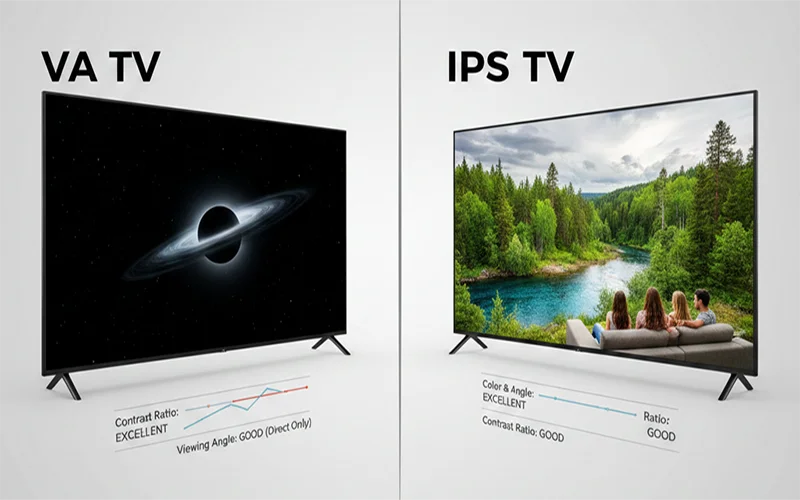
| Feature | VA Panel | IPS Panel |
| Black Levels | Deep, true blacks | Grayish/Dark blue blacks |
| Contrast | High (5,000:1+) | Low (1,000:1) |
| Viewing Angles | Narrow (Colors fade at angles) | Wide (Consistent at angles) |
| Color Accuracy | Good | Excellent (Standard for Pros) |
| Best Environment | Dark rooms / Home theaters | Bright rooms / Wide seating |
Which Should You Buy?
Choosing between VA and IPS isn't about which is "better" in a vacuum; it’s about your environment.
Choose a VA Panel if:
- You primarily watch movies or play immersive games at night or in a dim room.
- You sit directly in front of the screen.
- Deep blacks and "pop" are more important to you than wide-angle viewing.
Choose an IPS Panel if:
- You have a wide living room where people sit at various angles.
- You use the TV as a PC monitor for color-critical work (photo/video editing).
- You mostly watch sports or news in a bright, sunlit room where the lack of deep blacks won't be as noticeable.