
Sony 2026 TV Lineup: Which BRAVIA Should You Buy?
But those two models are only part of the buying decision. Sony also has a new BRAVIA 6 OLED, an upgraded BRAVIA 3 II, and familiar sets such as the BRAVIA 8 II and BRAVIA 5 that remain relevant despite arriving before 2026.
Sony 2026 TV lineup, in brief: BRAVIA 9 II is the flagship True RGB model, BRAVIA 7 II brings that technology to more sizes, and BRAVIA 6 adds a new OLED option. BRAVIA 8 II remains the premium QD-OLED choice, while BRAVIA 5, BRAVIA 3 II and BRAVIA 2 II cover different LCD budgets.
The trick is to compare the actual televisions. A higher number, a newer release date and a larger screen do not always point to the same purchase.
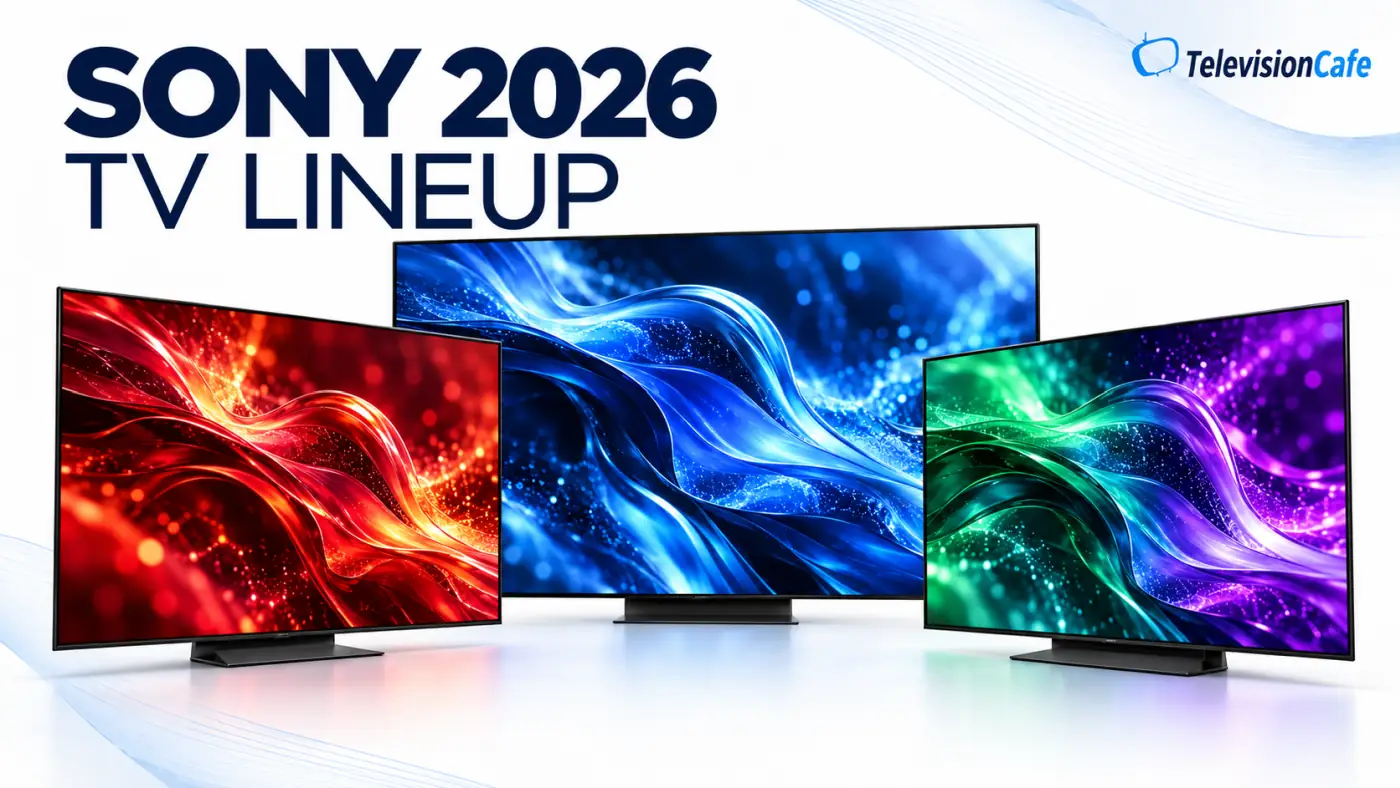
Sony 2026 TV Lineup at a Glance
This overview covers Sony's core current BRAVIA range using official U.S. and UK listings. Availability and model codes vary by country; older sets may also remain in retailer stock.
| Series | Display technology | Listed sizes | Release context |
|---|---|---|---|
| BRAVIA 9 II | True RGB LCD | 65, 75, 85, 115 inches | New for 2026 |
| BRAVIA 7 II | True RGB LCD | 50, 55, 65, 75, 85, 98 inches | New for 2026 |
| BRAVIA 8 II | QD-OLED | 55, 65 inches | 2025 model continuing in the range |
| BRAVIA 8 | OLED | 55, 65, 77 inches | 2024 model continuing in the range |
| BRAVIA 6 | OLED | 48, 55, 65, 77, 83 inches | New for 2026 |
| BRAVIA 5 | Mini LED LCD | 55, 65, 75, 85, 98 inches | 2025 model continuing in the range |
| BRAVIA 3 II | Direct LED LCD | 43, 50, 55, 65, 75, 85, 100 inches | New for 2026 |
| BRAVIA 2 II | Direct LED LCD | 43, 50, 55, 65, 75 inches | Regional rollout; U.S. model listed as 2025 |
The lineup year is not the release year of every TV. Sony's 2026 shopping range includes older models. BRAVIA 2 II makes the regional issue especially clear: Sony lists it as a 2025 model in the U.S., while its UK introduction was announced in March 2026.

What Is Sony True RGB, and Why Does It Matter?
True RGB uses independently driven red, green and blue LEDs behind an LCD panel. Sony controls those light sources with RGB Backlight Master Drive Pro, aiming to improve color volume and the handling of bright, colorful scenes.
Color volume is about keeping colors convincing across different brightness levels. A brilliant red stage light, for example, should remain richly red rather than washing out as it gets brighter.
That is a promising direction for daytime viewing and colorful HDR. It does not remove the need to assess contrast, reflections, motion and local dimming on the finished television.
True RGB is still LCD. Sony's BRAVIA 9 II specifications list an LCD panel with RGB LED backlighting and local dimming. These are not OLED or self-emissive MicroLED televisions.
For the broader technology comparison, read our RGB Mini LED vs OLED guide.
BRAVIA 9 II: Sony's Flagship True RGB TV
The BRAVIA 9 II is the premium showcase for Sony's new backlight technology. Sizes run from 65 to 115 inches, with 75- and 85-inch options between them.
Sony pairs True RGB with RGB Triluminos Max, Luminance Booster Pro and its XR Processor. The flagship also adds Immersive Black Screen Pro, a screen treatment designed to reduce glare and reflections, plus Acoustic Multi-Audio+ with up-firing beam tweeters on supported sizes.
The 115-inch model needs its own specification check. Sony excludes it from the advertised Immersive Black Screen Pro and beam-tweeter features. Stand design also varies by size.
My starting shortlist would put the 9 II in a bright living room where premium HDR and a large picture are priorities. That is a recommendation based on its design and features, not a claim that it wins every picture-quality comparison.
Before buying the enormous version, check delivery access, mounting requirements and seating distance. A screen that fits the wall can still be a poor fit for the room.
For a closer look at picture quality, gaming connections and differences between screen sizes, read our Sony BRAVIA 9 II review.
BRAVIA 7 II: True RGB in More Practical Sizes
The BRAVIA 7 II brings Sony's True RGB approach to 50, 55, 65, 75, 85 and 98 inches. That gives it a wider reach than the flagship, especially for buyers who want a premium LCD without starting at 65 inches.
It shares RGB Backlight Master Drive Pro, the XR Processor and X-Wide Angle Pro with the new True RGB family. It also supports 4K/120 gaming, VRR and ALLM.
The sensible comparison is a same-size 7 II against a 9 II or an OLED at a similar selling price. Watch subtitles over a dark scene, bright sports footage and faces under ordinary indoor lighting.
If the flagship's screen treatment, backlight performance or audio features do not bring a meaningful improvement in your room, the 7 II deserves serious consideration. Its place below the 9 II does not automatically make it the less satisfying purchase.
If daytime viewing is your priority, our guide to the best TVs for bright rooms in 2026 explains what to look for in brightness, reflections and screen placement.
BRAVIA 8 II: The QD-OLED Choice Still Matters
The BRAVIA 8 II remains Sony's premium QD-OLED option in the current range. It is a 2025 model, offered in 55 and 65 inches, rather than a newly introduced 2026 television.
Its appeal comes from self-lit pixels, strong color capability and Sony's XR processing. Acoustic Surface Audio+ uses actuators behind the screen to help place sound where the action appears.
For movies watched mainly after dark, it belongs beside the new True RGB models on your shortlist. OLED's individual pixel control remains a useful distinction when you watch subtitles, stars or small bright details against black.
The obvious limitation is size. There is no listed 77- or 83-inch BRAVIA 8 II in this core range. If you want a larger Sony OLED, look at the BRAVIA 8 and BRAVIA 6.
Our Sony BRAVIA 8 II review takes a closer look at its position in Sony's OLED range.
BRAVIA 8: An Older OLED Worth Comparing on Price
The BRAVIA 8 continues from Sony's 2024 range in 55, 65 and 77 inches. It is an OLED model, but it is not the QD-OLED BRAVIA 8 II.
It combines an XR Processor with XR Clear Image and Acoustic Surface Audio+. Those features keep it relevant for buyers who care about movie presentation and built-in dialogue placement.
The 77-inch option is especially useful when the 65-inch limit of the 8 II is too restrictive. Compare it with the newer BRAVIA 6 at the same size, including their processing, sound and connections.
An older release date does not make the 8 a poor purchase. The question is whether its actual selling price makes sense beside the alternatives available now.
BRAVIA 6: A New OLED from 48 to 83 Inches
The BRAVIA 6 is a new 2026 OLED series with 48-, 55-, 65-, 77- and 83-inch options. It expands Sony's OLED choice at both ends of the size range.
Sony highlights Triluminos Pro, automatic brightness adjustment, Google TV and Dolby Vision support. It also advertises four HDMI 2.1 ports with 4K/120, VRR and ALLM; the U.S. 65-inch specifications list VRR on all four inputs.
That makes it particularly worth comparing if you have several gaming devices, want a smaller OLED, or are looking beyond 77 inches.
Do not assume it is simply a BRAVIA 8 II in additional sizes. Compare image processing, HDR performance, screen reflections and built-in sound before deciding which OLED offers better value.
For a movie-and-gaming household, I would put the 6 on the list early. Then I would check whether the 8 or 8 II brings benefits worth the difference in price.
BRAVIA 5: Mini LED Without the True RGB Premium
The BRAVIA 5 is Sony's continuing 2025 Mini LED model, offered in 55, 65, 75, 85 and 98 inches. It is a different backlight design from the new True RGB 7 II and 9 II.
Its feature set includes the XR Processor, XR Clear Image and XR Backlight Master Drive local dimming. That makes it a useful comparison for buyers who want Sony's processing and an LCD screen without paying for the newest backlight family.
It also creates an interesting size-versus-tier decision. Depending on local deals, a larger BRAVIA 5 may compete with a smaller 7 II.
Check both at your viewing distance. A modest improvement in picture quality is not always more valuable than the extra screen area you notice throughout every movie or match.
BRAVIA 3 II: The Affordable Model Has a Real Gaming Upgrade
The BRAVIA 3 II is a new 2026 direct-LED LCD series, listed from 43 to 100 inches. Its sizes include 43, 50, 55, 65, 75, 85 and 100 inches.
Two features make it more interesting than its modest number suggests: Sony's XR Processor and support for 4K/120, VRR and ALLM. Sony advertises four HDMI 2.1 ports, and the U.S. 65-inch specifications list VRR on inputs 1 through 4.
Do not apply an older BRAVIA 3 specification to the 3 II. The exact model generation matters here, particularly when checking gaming features.
Its attraction is access to useful processing and high-frame-rate gaming at a lower tier. It should not be expected to match the backlight control of a Mini LED or True RGB model.
For someone choosing between a basic 60Hz TV and a more gaming-friendly Sony, this is one of the first models I would compare.
BRAVIA 2 II: The Entry-Level Option
The BRAVIA 2 II covers the basics: a direct-LED LCD screen, 4K Processor X1 and Google TV, with sizes from 43 to 75 inches.
It is better suited to ordinary television, streaming and casual gaming than to a setup built around 4K/120 and VRR. Sony's U.S. 65-inch specifications list a 60Hz panel, no VRR, and HDR10/HLG compatibility.
Its model year also needs context. The U.S. version is listed as 2025, while Sony announced its UK introduction in 2026. A regional launch date does not necessarily describe a brand-new television worldwide.
Compare its price with the BRAVIA 3 II before buying. If the difference is manageable, the 3 II's processing and gaming features may be worth the step up.
Gaming: HDMI Features Are Not the Same Across the Range
Sony's 2026 range is more varied than the familiar advice that every advanced BRAVIA has two gaming-capable HDMI inputs. Check the exact TV before planning your connections.
| Model checked | 4K/120 support | VRR inputs |
|---|---|---|
| BRAVIA 9 II — K-65XR95M2 (UK) | Yes | HDMI 3 and 4 |
| BRAVIA 7 II — K-65XR75M2 (UK) | Yes | HDMI 3 and 4 |
| BRAVIA 6 — K-65A60 (U.S.) | Yes | HDMI 1, 2, 3 and 4 |
| BRAVIA 3 II — K-65XR30M2 (U.S.) | Yes | HDMI 1, 2, 3 and 4 |
| BRAVIA 2 II — K-65S20M2 (U.S.) | No | None |
These are specific verified examples, not a promise that every regional version has identical connections. Also check which input handles eARC when adding a soundbar or receiver.
For PS5 and Xbox Series X, 4K/120, VRR and responsive Game mode are useful priorities. PC gamers should check supported signals instead of assuming the newest Sony model accepts 144Hz or 165Hz.
If your sound system complicates the setup, our HDMI ARC/eARC troubleshooting guide covers common connection problems.
Dolby Vision, Google TV and the Features to Check Individually
True RGB describes the display's backlight. It does not tell you which HDR formats a television supports.
The checked BRAVIA 9 II and BRAVIA 6 specifications list HDR10, HLG and Dolby Vision. The checked BRAVIA 2 II lists HDR10 and HLG. Dolby Vision should therefore not be assumed across every model simply because it carries the BRAVIA name.
Google TV is central to the range. Sony's U.S. listings also advertise Gemini on selected TVs, with conditions covering supported countries, languages and software updates. Check local availability if voice and assistant features affect your purchase.
On supported models, Studio Calibrated modes and Sony's home-theater integration add useful options. Choose those features for services and equipment you actually use, rather than treating every logo as another reason to spend more.

Sony 2026 TV Prices: Compare the Same Screen Size
To show the price gaps without mixing screen sizes, these are Sony's advertised U.S. prices for selected 65-inch models checked on October 4, 2026. They are current selling prices, including promotions where shown, rather than a universal launch-price list.
| 65-inch model | Advertised U.S. price |
|---|---|
| BRAVIA 9 II | $3,599.99 |
| BRAVIA 7 II | $1,799.99 |
| BRAVIA 6 | $1,699.99 |
| BRAVIA 3 II | $899.99 |
Promotions can make the hierarchy look surprisingly uneven. That is why buying advice should follow the price available today, rather than the number printed after BRAVIA.
Outside the U.S., compare local pricing, warranties and the full model code. A currency conversion does not capture regional taxes, offers or differences in the range.
Which Sony BRAVIA Should You Buy in 2026?
Start with your room and viewing habits, then narrow the range. These are our starting shortlists based on display type, available sizes and documented features.
- Bright-room viewing with a premium budget: compare BRAVIA 9 II and BRAVIA 7 II.
- Movies after dark at 55 or 65 inches: include BRAVIA 8 II alongside the True RGB alternatives.
- A smaller or larger Sony OLED: BRAVIA 6 opens up 48- and 83-inch choices; BRAVIA 8 remains another 77-inch option.
- A large LCD at a more manageable price: compare BRAVIA 5 with BRAVIA 7 II and BRAVIA 3 II at the size you need.
- Gaming on a tighter Sony budget: check BRAVIA 3 II before settling for BRAVIA 2 II.
Use our TV size guide before paying for a higher tier that leaves you with a screen too small for your seating distance.
At TelevisionCafe, our buying priority is the picture you see from your own seat. True RGB is the headline, but the right Sony TV is the one whose size, performance and price fit how you watch.
Sony 2026 TV Lineup FAQ
Which Sony TVs are new for 2026?
The new core models include BRAVIA 9 II, BRAVIA 7 II, BRAVIA 6 and BRAVIA 3 II. The current shopping range also includes older models. BRAVIA 2 II has different introduction dates across markets.
Is Sony True RGB an OLED technology?
No. The BRAVIA 9 II and BRAVIA 7 II use RGB backlighting behind an LCD panel. OLED creates light at the individual pixels and does not use that backlight structure.
Is BRAVIA 8 II a 2026 model?
No. Sony lists BRAVIA 8 II as a 2025 QD-OLED model. It remains part of the current range in 55 and 65 inches.
Does Sony sell a 48-inch or 83-inch OLED in 2026?
Yes. BRAVIA 6 is listed in 48, 55, 65, 77 and 83 inches. Check local stock and the regional model code.
Does BRAVIA 3 II support 4K at 120Hz?
Yes. Sony advertises 4K/120, VRR and ALLM for BRAVIA 3 II. The checked U.S. 65-inch model lists VRR on all four HDMI inputs.
Is the 115-inch BRAVIA 9 II identical to the smaller sizes?
No. Sony excludes the 115-inch version from certain advertised features, including Immersive Black Screen Pro and the up-firing beam-tweeter feature. Check its own specifications before buying.