
Best 65-Inch TVs Under $1,000 in 2026: 5 Worth Buying
A $1,000 ceiling is enough for a genuinely good 65-inch TV in 2026. It can buy Mini LED contrast, strong HDR highlights and useful gaming features. The catch is that a model advertised “from $699” may reach that price only at 55 inches, while the 65-inch version costs much more.
We checked U.S. listings for the specific 65-inch versions on September 25, 2026, then weighed those prices against published specifications and independent testing. Two of the best deals are 2025 models still on sale in 2026; their model years are clearly marked below. Prices are before tax and optional delivery or installation charges, and promotions can end without warning.
Our quick picks: The TCL QM7K is the strongest all-around value at its checked sale price. The Hisense U7SG makes more sense when a window faces the screen. The TCL QM7L brings richer, brighter HDR color if it stays below $1,000. For the lowest spend, start with the Roku Select Series.
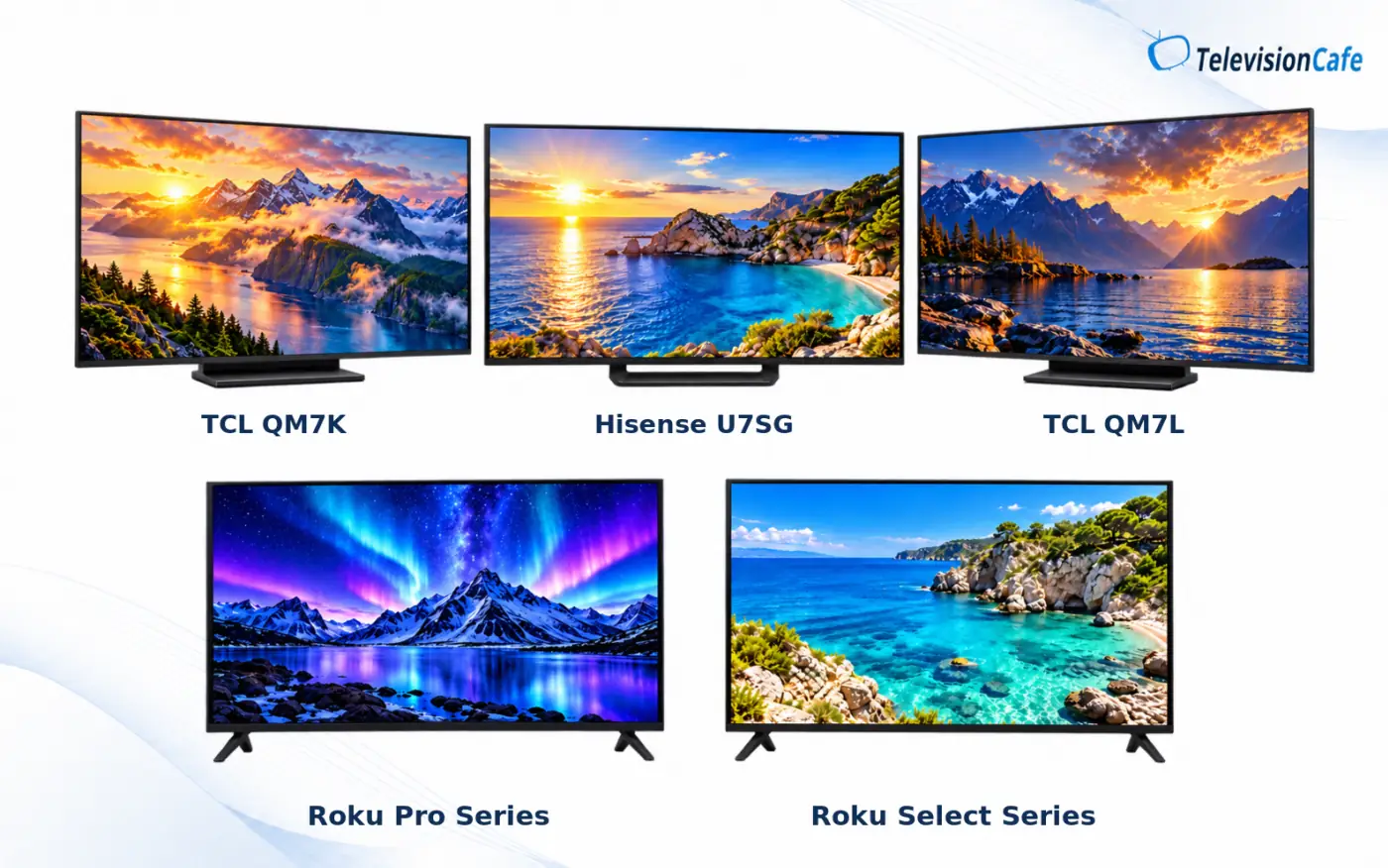
Best 65-Inch TVs Under $1,000: Price Snapshot
| 65-inch TV | Listed U.S. price* | Best reason to buy | Main compromise |
|---|---|---|---|
| TCL QM7K (2025) | $699.99 | Movies and responsive gaming for less | Direct reflections; older stock |
| Hisense U7SG (2026) | $847.99 | Bright rooms and multiple gaming devices | Sports motion and screen uniformity |
| TCL QM7L (2026) | $999.99 | Colorful, punchy HDR | Gaming motion; sale-dependent price |
| Roku Pro Series (2025) | $899.99 | Roku interface with Mini LED | Less accurate HDR than rivals |
| Roku Select Series (2026) | $399.99 | Simple streaming on a tight budget | Basic backlight and HDR |
*Prices observed September 25, 2026, for U.S. 65-inch listings, before tax; check the linked seller pages before ordering. A TV costing $999.99 qualifies on its listed price, but local sales tax will take the checkout total above $1,000.
TCL QM7K: The Best All-Around Deal While Stock Lasts
The surprise of this list is a 2025 TV. At $699.99 for the 65-inch QM7K, TCL's older Mini LED set is easier to recommend than plenty of newer TVs costing the same or more. It delivers deep blacks, lively HDR and Google TV, with 4K at up to 144Hz and VRR for a gaming PC or current consoles.
Independent testing finds its Game Master mode more responsive in motion than the newer QM7L's gaming mode. That matters more in a fast game than a larger number printed on a box. For movies, local dimming does a good job of keeping nighttime scenes convincing, though some artifacts can show around fast-moving colors.
The catch is a window directly opposite the TV: its reflection handling is less reassuring than the U7SG's matte screen. And because the QM7K is a 2025 model, verify that you are buying a new 65QM7K from available stock at the price shown, not a similarly named QM6K or a more expensive marketplace listing. See the independent 65-inch review.
Hisense U7SG: The Pick for a Bright Living Room
For a screen facing a window, the 65-inch U7SG earns its place at the $847.99 price checked for this guide. Its matte treatment cuts sharply defined reflections, and its high brightness helps ordinary shows and HDR stay readable in daylight. This is one of the few differences you can notice before comparing any test charts.
It also offers four HDMI inputs with HDMI 2.1 bandwidth, low input lag and VRR. That is useful if a console, gaming PC and sound system all need a place. Its local dimming gives films good depth after dark, too.
Know the tradeoff: A high refresh-rate specification does not guarantee sharp sports. Tests found blur, color artifacts in fast action and some visible screen uniformity issues on the 65-inch U7SG. If hockey, soccer or fast camera pans fill your evenings, compare its motion with the TCL QM7K before buying.
Considering this model? Our Hisense U7SG review takes a closer look at its features, size-specific differences, and what to check before buying.
TCL QM7L: Vibrant HDR at the $1,000 Line
The 2026 QM7L is the model to consider if you want the biggest sense of color and HDR impact without crossing the stated ceiling. TCL's U.S. store listed the 65QM7L for $999.99 when we checked. Its Mini LED contrast and very high brightness give films and games real punch, and it supports both Dolby Vision and HDR10+.
There are two reasons not to grab it automatically. First, this recommendation only applies while the 65-inch price remains below $1,000. Second, independent testing found slow pixel transitions in its dedicated gaming mode, making quick movement blurrier than the 144Hz label suggests. Dark scenes can also pick up a distracting mirror-like reflection from a window opposite the screen.
If the price rises or gaming clarity comes first, buy the QM7K instead. If vivid HDR is your priority and your room avoids direct reflections, the QM7L earns the extra spend. See the independent QM7L test.
For a closer look at the strengths and compromises, read our TCL QM7L review. Already own one? Start with our TCL QM7L best picture settings guide to set up SDR, HDR, and gaming profiles for your room.
Roku Pro Series: The Better Roku TV
If the Roku home screen is what everyone in the house knows, there is no need to settle for a basic panel. The 65-inch Roku Pro Series 2025 was listed at $899.99. It brings Mini LED local dimming and 120Hz gaming capability to Roku's straightforward interface.
It can handle a mix of bright-room TV, movies and consoles. Its weakness is HDR accuracy: independent tests found it less faithful to the source than the strongest TCL and Hisense alternatives, and lower-quality video processing is only middling. Buy it because you genuinely prefer Roku and want a stronger picture than an entry-level Roku TV can provide, rather than because it beats the QM7K or U7SG on raw picture value.
This is another 2025 model still sold in 2026. Check the model number 65R8C5 and the independent review before ordering.
Roku Select Series: A 65-Inch TV for the Smallest Budget
At a checked price of $399.99, the 2026 Roku Select Series leaves room in the budget for a soundbar or a decent wall mount. It gives you a 65-inch 4K QLED screen, Roku's familiar menus and straightforward access to streaming apps.
Keep the price class in mind. This is a direct-lit TV, without the Mini LED local dimming that gives the other picks their stronger HDR contrast. Roku lists HDR10 support, but this is a casual streaming choice, not a substitute for a higher-tier set if you expect dramatic movie highlights or advanced gaming.
When to spend more: If you watch movies most nights, the jump from this Roku to the $699.99 QM7K buys a more substantial picture improvement than the jump from one basic LED brand to another.
Three Checks Before You Buy a $1,000 TV
- Match the exact 65-inch model code. QM7K, QM7L and QM6K sound similar but are different TVs. So are Roku Select and Roku Pro. A search result may default to a cheaper 55-inch option.
- Check the room and the content. Choose the U7SG when direct window reflections dominate; consider the QM7K for darker-room movies and sharper gaming motion. A wide seating arrangement deserves a separate look at viewing-angle performance.
- Check today's sale and stock. The QM7L qualifies here at $999.99 before tax, with no room for a price increase. A discontinued model is only a deal if a new unit is available at the advertised price.
Mini LED and OLED can suit very different rooms. Our OLED vs. Mini LED guide explains the larger tradeoffs if you are considering an OLED sale as well.
Which 65-Inch TV Under $1,000 Should You Buy?
At the prices checked for this article, we would buy the TCL QM7K for the broadest mix of movies and games. Its 2025 badge is less important than the performance you get for $699.99. Choose the Hisense U7SG instead if your room has a window reflected in the screen or you need more high-bandwidth gaming connections.
Spend up to the TCL QM7L only if its 65-inch price is still below $1,000 and vibrant HDR matters more to you than fast gaming motion. The Roku Pro Series is a sensible preference pick for committed Roku users. The Roku Select Series keeps the purchase inexpensive and the experience simple.
If your final choice comes down to the two newer Mini LED models, read our TCL QM7L vs Hisense U7SG comparison before deciding which trade-offs matter most to you.
At TelevisionCafe, we would check the final cart price and model number one last time before paying. Both can change the answer more quickly than a new television launch.
Frequently Asked Questions
Can you really buy a good 65-inch TV for less than $1,000?
Yes. At the U.S. prices checked on September 25, 2026, the 65-inch TCL QM7K, Hisense U7SG and TCL QM7L all fall below $1,000 before tax. Prices and stock can change, so verify the exact screen size at checkout.
Is a 2025 TV still worth buying in 2026?
It can be if it is new, available and priced well against current alternatives. The 65-inch TCL QM7K is a strong example at its checked sale price. Compare performance and retailer terms, not just the model year.
Which pick is best for PS5 or Xbox?
The TCL QM7K is the stronger value for clear, responsive gaming at the checked prices. The Hisense U7SG adds four HDMI 2.1-bandwidth inputs for a more crowded setup, but its motion can look softer. The Roku Pro Series supports 4K at 120Hz if you prefer Roku's interface.
Is the cheapest Roku Select Series a Mini LED TV?
No. The 2026 Roku Select Series recommended here is a direct-lit QLED LCD. The more expensive Roku Pro Series uses Mini LED local dimming and delivers stronger contrast.