
Panasonic Z95B Review: Still Worth Buying in 2026?
The Panasonic Z95B is still worth considering in 2026, especially if you want a movie-focused OLED and plan to use its built-in speakers. The harder question is how much extra that combination is worth when a less expensive OLED and a separate soundbar might fit your room better.
This isn't simply a discontinued model getting one last recommendation. Panasonic's August 2026 U.S. lineup announcement explicitly carries the Z95B over from 2025. Its model year is older; its place in the lineup remains current.
Quick Verdict
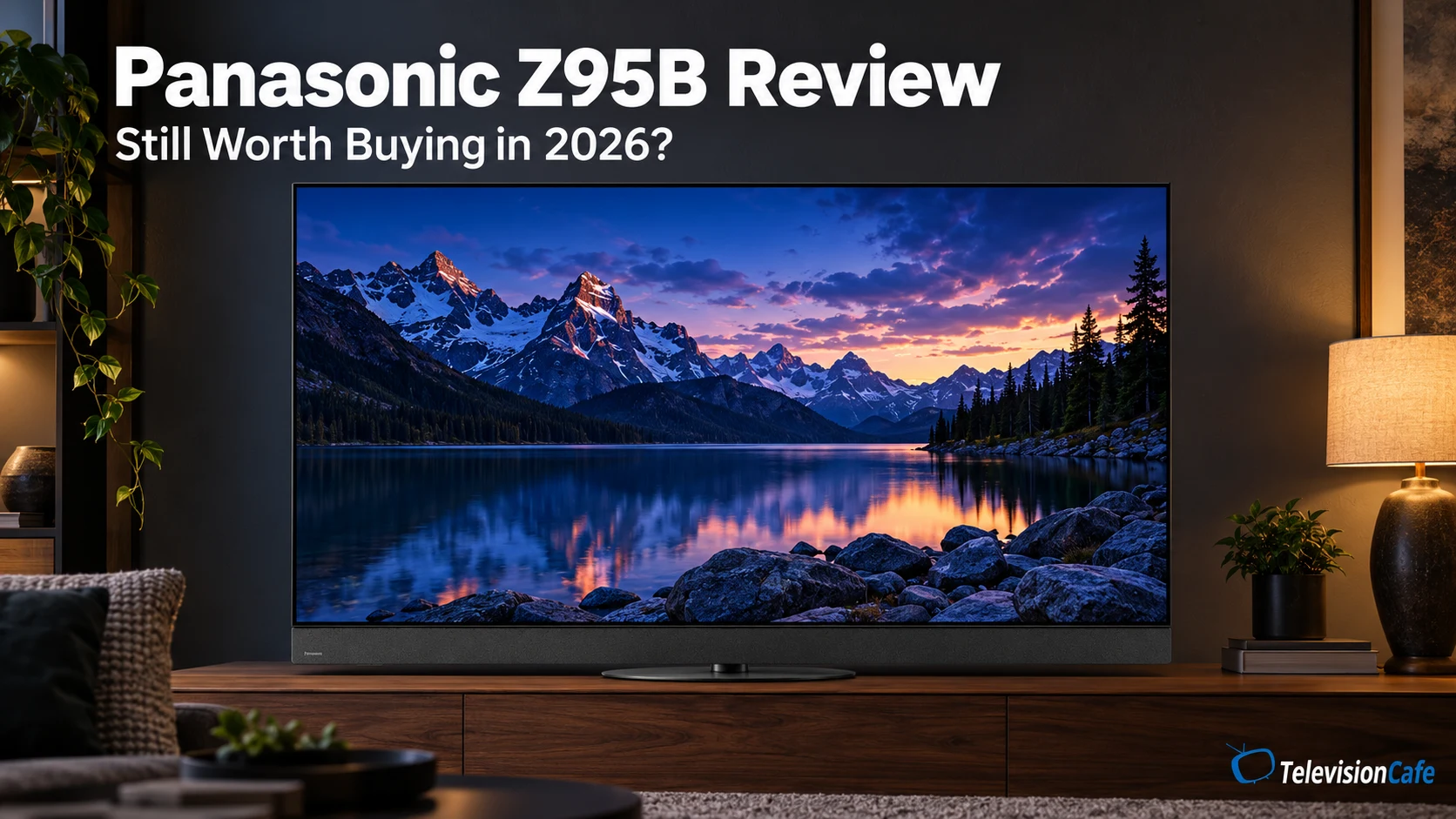
Buy it for movies and a simpler audio setup. The Z95B combines OLED black levels, Dolby Vision and HDR10+ support, and an unusually substantial integrated speaker system. It makes the most sense when you want premium picture and sound without adding another box beneath the screen.
Be more selective if you already own good speakers. You're paying for audio hardware you may barely use, while two high-bandwidth HDMI inputs can complicate a setup with multiple gaming devices and an eARC soundbar.
U.S. model covered: TV-65Z95BP. The 2025 range also included TV-55Z95BP and TV-77Z95BP. In Europe, the same Z95B family uses regional model codes such as TV-65Z95BEG. Tuners, services, firmware and warranty arrangements vary by market; don't treat an imported version as interchangeable with the U.S. set.
What Buying a Z95B in 2026 Actually Means
Panasonic's 2026 U.S. lineup announcement lists the Z95B in 55- and 65-inch sizes and says the series continues from 2025. That is different from assuming every size from the original launch remains readily available. The 77-inch model appears in the original U.S. documentation, but it isn't listed in that newer announcement.
The 65-inch TV-65Z95BP launched at $3,399.99. That's a historical launch price, not a verified October 2026 offer. During our October 24, 2026 source check, the Amazon listing we could inspect showed unavailable, and Panasonic's newer U.S. product page was labeled coming soon. Neither gives us a dependable, in-stock checkout price to quote.
Our buying target: around $2,500 or less for a new 65-inch U.S. unit from an authorized seller would make it worth a close look. That is an editorial target, not an advertised deal. Above that, compare the total cost with competing OLEDs, including any soundbar you'd actually buy.
A listing alone doesn't settle the purchase. Check the full model number, seller, condition, delivery terms and applicable U.S. warranty. A cheaper import or open-box unit belongs in a different comparison from a new TV with straightforward local support.
Panasonic Z95B Specs: The Details That Matter
| Feature | U.S. Z95B |
|---|---|
| Display | 4K Primary RGB Tandem OLED, 3840 × 2160 |
| Processing and cooling | HCX Pro AI Processor MK II; ThermalFlow cooling |
| Maximum refresh rate | Up to 4K at 144Hz from a compatible source |
| HDR formats | Dolby Vision IQ, HDR10+ Adaptive, HDR10 and HLG |
| HDMI | Four inputs; high-frame-rate 4K and VRR on HDMI 1 and 2; eARC on HDMI 2 |
| Gaming features | ALLM, VRR, AMD FreeSync Premium and NVIDIA G-SYNC Compatible |
| Smart platform | Fire TV with hands-free Alexa |
| Built-in sound | 360° Soundscape Pro, tuned by Technics; Dolby Atmos |
Those specifications explain compatibility. They don't tell you how bright an entire hockey rink looks, how a lamp reflects in the screen, or whether the speakers suit your room.
Picture Quality: Why Movie Fans Should Pay Attention
The Z95B's OLED pixels can switch off independently. Subtitles against a dark scene don't need a backlight zone that also illuminates the surrounding picture. If glowing captions bother you on an LCD, this is a practical reason to consider OLED before getting lost in processor names.
Panasonic's Primary RGB Tandem branding describes the OLED emission structure. This remains a WOLED design, rather than a QD-OLED panel or an RGB Mini LED backlight. ThermalFlow is Panasonic's cooling approach, not a guarantee of a particular brightness level or immunity to burn-in.
RTINGS tested the 65-inch TV-65Z95BP and found excellent upscaling and strong cleanup of low-quality content, alongside accurate color. It also reported more visible banding in Dolby Vision than HDR10 and some stutter during slow camera movement. Those are useful qualifications to a strong movie recommendation.
For an older show, processing can make compression less distracting, but it can't recover detail that never reached the TV. A better stream or disc still matters. Our TV upscaling guide explains where that improvement ends.
Why the HDR Brightness Numbers Need Context
TechRadar's 65-inch review measured about 992 nits in Filmmaker Mode with its initial HDR test signal. Raising the source's mastering luminance produced a reading of 2,107 nits while maintaining accurate tracking. The higher figure describes a specific test condition, not the brightness of every HDR scene.
Tom's Guide also tested a 65-inch unit and reported 983 nits on a 10% HDR window, rising to 2,263 nits after changing the brightness limitation setting. These are separate tests with different adjustments; they shouldn't be averaged or presented as an improvement measured by this site.
The buying implication is more useful than either headline number: the Z95B can deliver bright HDR highlights, but its accurate modes may look more restrained than expected with some material. Don't assume a darker presentation means the panel has reached its limit.
Start with an accurate movie preset, check it with familiar content in your usual lighting, and change one control at a time. Avoid copying someone else's white-balance settings. For the purpose of these modes, see Filmmaker Mode vs Movie Mode.
Bright Rooms, Sports and Wide Seating
A bright OLED still needs sensible placement. TechRadar noticed mirror-like reflections from lamps and overhead lighting on its review unit. Before paying for a more expensive panel, check whether a small change to the TV angle or a lamp position would remove a reflection from your favorite seat.
RTINGS found a very wide viewing angle on its 65-inch sample. That makes the Z95B appealing for seating spread across a room. It doesn't mean every seat gets an identical experience: distance, reflections and the angle of the speaker system also change what you see and hear.
For daytime sports, think about the whole picture rather than a small HDR highlight. A bright field or rink places different demands on an OLED than a night scene with a few lights. If your room is flooded with daylight for most of your viewing, compare the Z95B with the options in our bright-room TV guide before deciding.
Motion also depends on the source. A fast panel doesn't turn a low-frame-rate broadcast into a high-frame-rate feed. With movies, a little interpolation may soften stutter, but too much changes the look of the film. Adjust to taste using the content you actually watch.
Built-In Sound Is a Real Reason to Choose It
The fabric-covered speaker section gives this TV a different look from an OLED designed around a nearly invisible chassis. Panasonic's 360° Soundscape Pro system includes forward-, side- and upward-firing elements tuned by Technics.
TechRadar praised its clear, spacious presentation. RTINGS found dialogue easy to understand, but also noted limited bass compared with separate audio equipment. The sensible expectation is unusually capable TV sound, with room to improve if you want deeper bass or speakers behind the sofa.
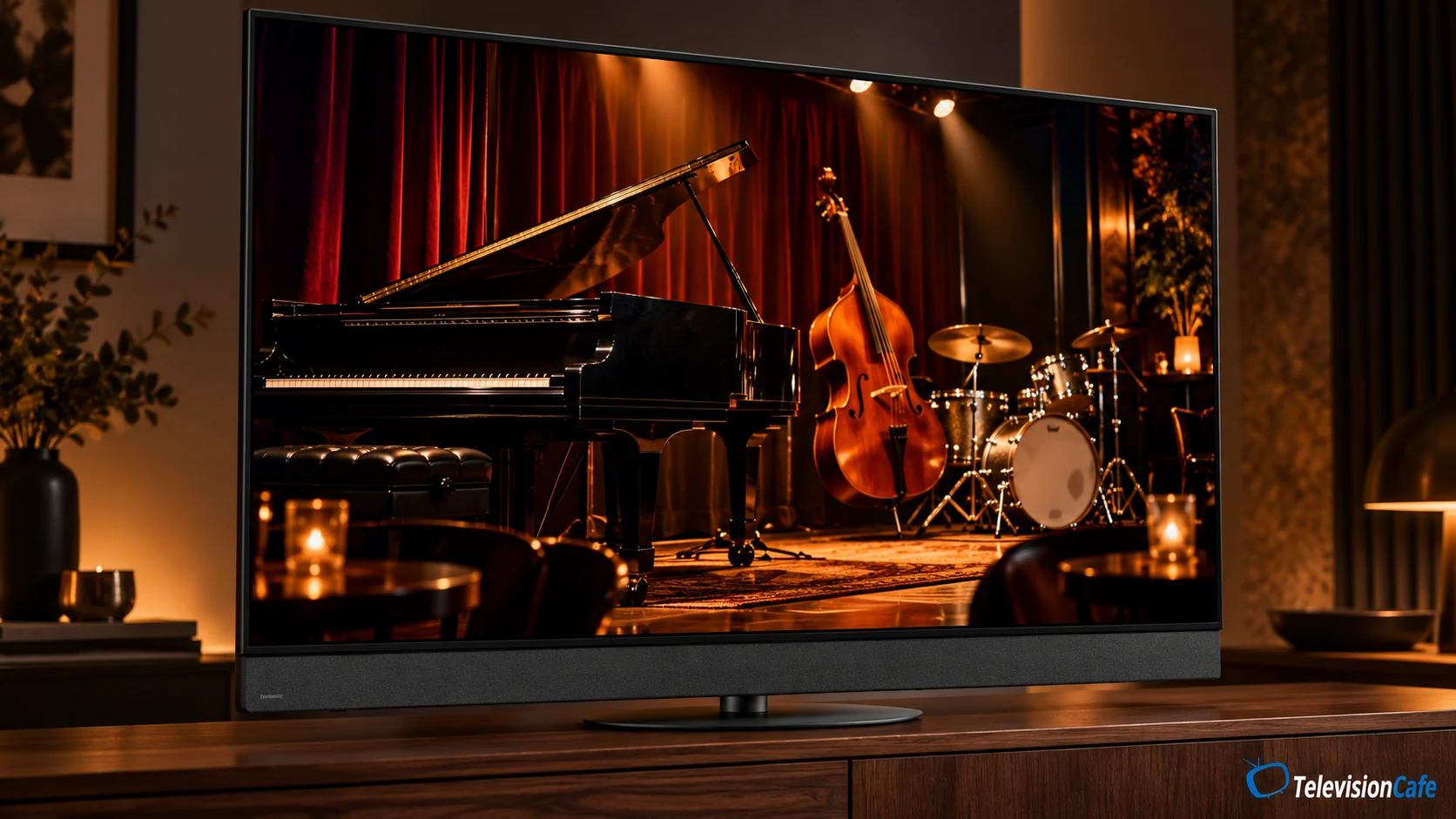
Editorial illustration of the U.S. 65-inch Z95B's design and integrated speaker bar; screen content is illustrative.
Try the internal system before ordering a soundbar. For news, dramas and everyday streaming, it may already do what you need. For loud action movies in a large room, a separate subwoofer and surround speakers solve problems that a speaker array inside the TV can't fully address.
Placement matters here, too. Don't enclose the TV tightly in cabinetry or block its upper and side speaker paths. Panasonic's U.S. specification sheet lists a swivel stand for the 55- and 65-inch sizes only; don't assume the 77-inch model turns the same way.
If you're budgeting for external audio anyway, compare complete systems using our soundbar buying guide. The Z95B's audio premium becomes less compelling when those built-in speakers will stay muted.
Gaming: Strong Support, With an HDMI Planning Problem
Panasonic specifies up to 4K at 144Hz, VRR and ALLM, with FreeSync Premium and G-SYNC Compatible support. The extra refresh-rate headroom is relevant to a compatible PC; current PS5 and Xbox Series X consoles top out at 120Hz output.
Tom's Guide measured 12.7ms of input lag on its 65-inch review sample. That is the publication's result under its test conditions, not a promise for every resolution, refresh rate or picture mode.
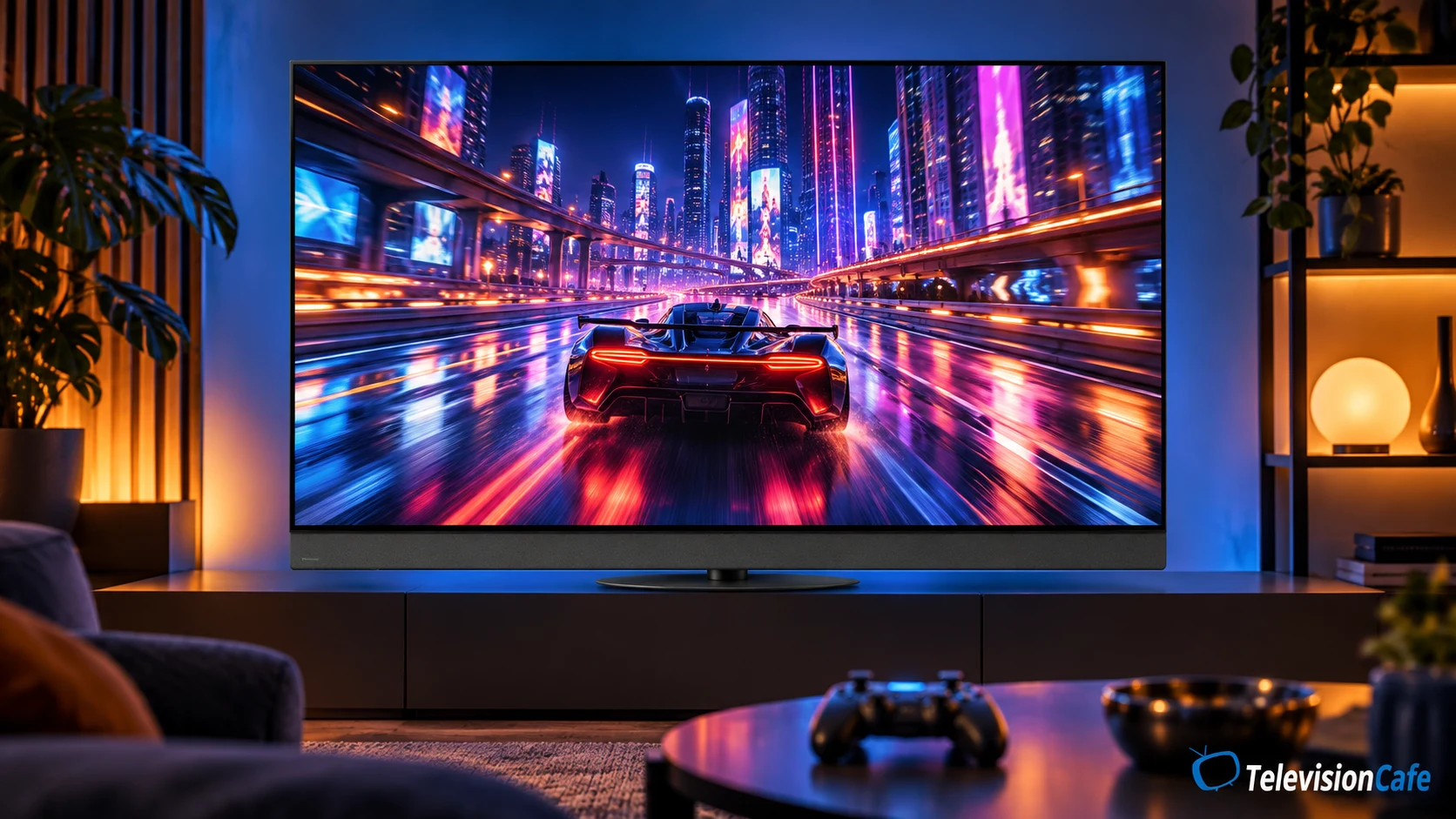
The connection layout deserves more attention than the maximum refresh rate. HDMI 1 and HDMI 2 handle high-frame-rate 4K and VRR. HDMI 2 is also eARC. With the internal speakers, you can connect two suitable gaming sources directly. Add an eARC soundbar without matching HDMI passthrough and only one of those TV inputs remains free.
A PS5, Xbox and eARC soundbar therefore need planning. You may have to move a cable, use a suitable switch, or route a source through audio equipment that explicitly supports the video features you need. Check 4K/120Hz, VRR and HDR passthrough individually; an HDMI label alone doesn't answer all three.
Physical-media users have another detail to consider: RTINGS found no DTS audio passthrough. If your discs use DTS soundtracks, plan a direct player-to-receiver or compatible soundbar connection instead of relying on the TV to pass everything through.
Fire TV and Everyday Ownership
Fire TV keeps streaming apps inside the television, with Alexa integration and a home screen built around content discovery. Its recommendations and promotions are part of the experience. If you prefer opening a small grid of your own apps, spend time with the interface before buying.
Panasonic's manual notes that services and menus can change with software updates. That is why an exact menu screenshot from a launch review may no longer match the TV you unpack in 2026. App availability, subscription tiers and playback formats also need checking for the services you use.
An external player is an option if the interface bothers you, but include it in the budget and HDMI plan. Our guide to using a streaming device with a smart TV covers when another box adds something useful.
As with other OLEDs, prolonged repeated static content deserves consideration. A household rotating through movies, shows and games has a different usage pattern from a screen displaying one news banner or desktop all day. Leave the TV's protection features enabled and follow the model's care instructions; cooling technology doesn't remove that tradeoff.
Which Alternatives Should You Compare?
Choose the comparison around what you'd actually change in your setup. A cheaper TV is only a better deal if it covers the same needs, and a more expensive model needs to solve a problem you'll notice.
- For a lower total bill: compare the Z95B with a discounted LG C5 or the LG C6. Work out the cost with your chosen audio system rather than comparing TV prices alone.
- For several gaming sources: scrutinize the HDMI layout of every candidate. Count the ports left after connecting your audio equipment, not just the number printed on the box.
- For an existing theater system: give less weight to the Z95B's speakers. Focus on picture presentation, audio routing, installation and the delivered price.
- For a sunlit room: compare reflections and sustained bright-scene performance. Our OLED vs Mini LED guide can help you decide which compromises fit the room.
Final Verdict
The Panasonic Z95B remains a convincing 2026 choice for movie fans who want an OLED with useful built-in sound and broad HDR compatibility. Its appeal is strongest in a setup where those speakers avoid another purchase and the two high-bandwidth HDMI inputs cover your devices.
For the 65-inch U.S. model, we'd start paying close attention around our $2,500 buying target, subject to seller, condition and warranty. If you already own good audio, need several high-frame-rate sources or find a substantially cheaper OLED, the case for paying extra becomes weaker. Buy the combination you'll use.
TelevisionCafe · 65-INCH U.S. MODEL
Panasonic Z95B 65-Inch OLED TV
TV-65Z95BP pairs Primary RGB Tandem OLED with Dolby Vision, HDR10+ and Technics-tuned built-in sound. Check the selected package, seller, condition and U.S. warranty before ordering.
Availability note: The listing inspected for this review showed unavailable. Current stock and pricing must be checked on Amazon.
Paid link. We may earn a commission.