
LG C6 vs G6: Is the More Expensive OLED Worth It?
The LG G6 earns its higher price when you need better daytime visibility or want more impact from HDR movies. The C6 is the easier buy when you mostly watch after dark, want the same core gaming features, or would rather spend the difference on a larger screen.
That price difference changes the answer more than the model names suggest. At LG USA on November 12, 2026, the 65-inch G6 cost $600 more than the 65-inch C6. At 55 inches, the gap was $900. Those are two very different buying decisions.
Models covered: This comparison focuses on the 2026 U.S. 55- and 65-inch C6 and G6: OLED55C6PUA, OLED65C6PUA, OLED55G6WUA, and OLED65G6WUA.
Regional names: The same C6 and G6 series names are used in the UK, with model numbers such as OLED65C64LA and OLED65G66LS. Local tuners, services, warranties, and stand or wall-mount packages can differ. Check the complete model number before applying buying advice from another country.
Size warning: Larger 77- and 83-inch C6 variants are commonly called C6H in specialist reviews and use different panel hardware. The 42- and 48-inch C6 and 97-inch G6 also need separate consideration. The conclusions below are aimed at the 55- and 65-inch models.
For the rest of LG's range and model naming, see our LG TV lineup and model guide.
LG C6 vs G6: Quick Verdict
Choose the LG C6 for movie nights in a room with manageable lighting, PS5 or Xbox gaming, and the lower total cost of a TV on a media console.
Choose the LG G6 if reflections regularly interrupt your viewing, HDR picture quality is a priority, or you specifically want its flush wall-mounted design. Its five-year limited panel warranty adds value, with coverage limits explained below.
Our value pick is the C6. The G6 is the upgrade for buyers who can point to a particular benefit they'll use often. Paying a large premium for occasional streaming in a dim room is harder to justify.
The Differences That Matter
| Feature | LG C6 | LG G6 |
|---|---|---|
| Display | 4K OLED evo; Brightness Booster | 4K Primary RGB Tandem 2.0 OLED; Brightness Booster Ultra |
| Main picture advantage | Lower cost for OLED contrast | Higher brightness, stronger HDR color, better direct-reflection handling |
| Processor | Alpha 11 AI Processor Gen3 | Alpha 11 AI Processor Gen3 |
| Gaming connections | Four HDMI inputs with HDMI 2.1 bandwidth; VRR and ALLM | Four HDMI inputs with HDMI 2.1 bandwidth; VRR and ALLM |
| Maximum PC refresh rate | Up to 4K at 165Hz | Up to 4K at 165Hz |
| HDR formats | Dolby Vision, HDR10, HLG | Dolby Vision, HDR10, HLG |
| Smart TV platform | webOS 26 | webOS 26 |
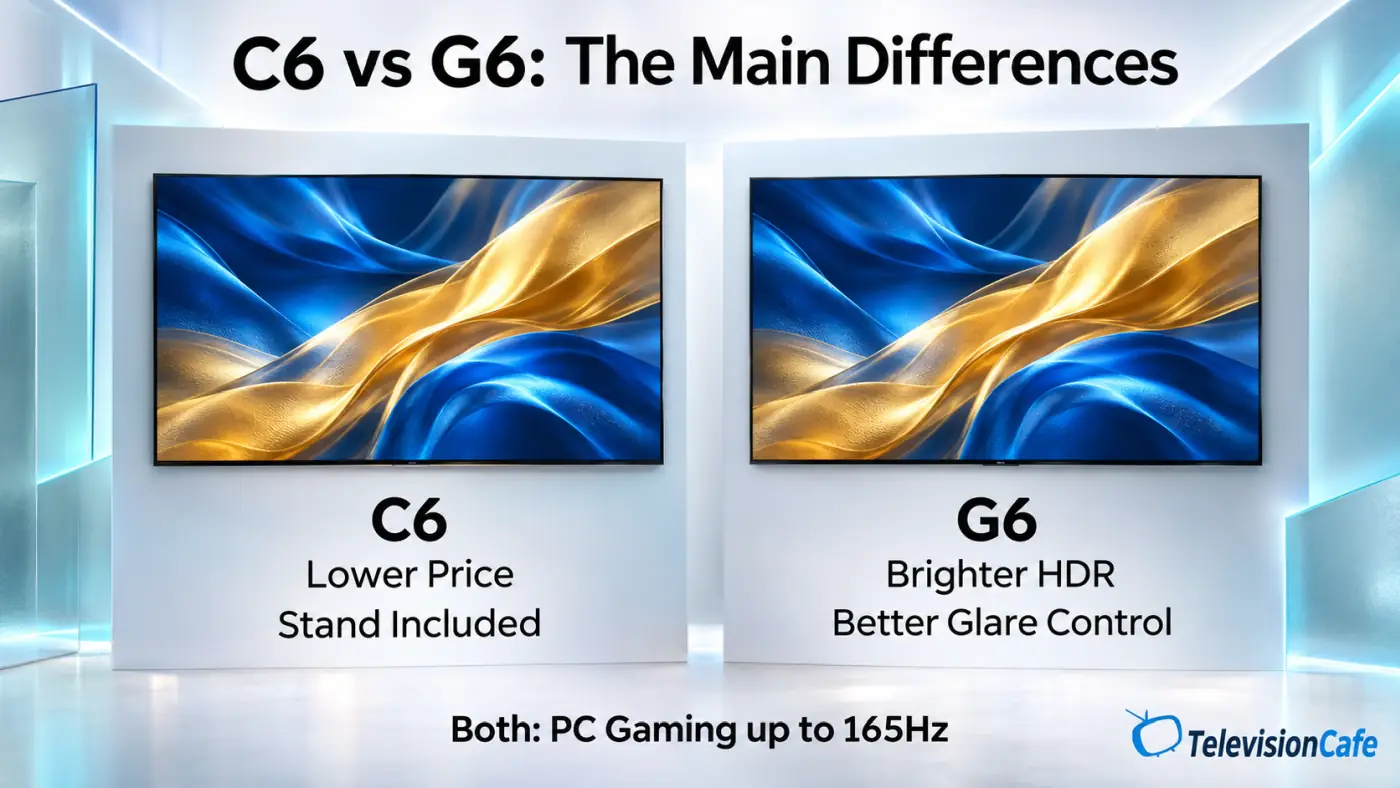
| Standard U.S. setup | Tabletop stand included | Flush wall mount included with G6WUA; stand separate |
Specifications come from LG's product information. Performance comparisons draw on RTINGS' 65-inch review samples. Its G6 sample was the Canadian OLED65G6SUB; RTINGS groups its picture performance with the U.S. G6WUA, while the supplied mounting hardware differs.
For more detail on each model, read our LG C6 OLED review and LG G6 OLED review.
Picture Quality: Where the G6 Pulls Ahead
Both TVs can switch individual pixels off, so you get the deep blacks that make OLED appealing for movies. Buying the C6 doesn't mean giving up that basic advantage. Dark backgrounds, letterbox bars, and bright subtitles don't depend on an LCD backlight divided into dimming zones.
The G6's extra capability becomes more relevant when the picture asks for bright highlights and rich color at the same time. RTINGS' 65-inch G6 review identifies higher brightness and more vibrant HDR color than the C6. That makes the G6 the more capable option for HDR picture quality in this comparison.
What does that mean from the couch?
Think about the content you put on deliberately for the picture: a well-mastered HDR movie, a nature documentary, or a visually ambitious game. That's where paying for more display capability has a clear purpose. A routine sitcom while you're cooking is a weaker reason to stretch the budget.
The gap also changes from scene to scene. In TechRadar's published side-by-side comparison, the G6 had a clear advantage in bright snowy footage, while some colorful movie scenes looked much closer. A higher peak-brightness number doesn't mean every face, wall, or landscape should look brighter.
For evening movie watching: The C6 remains our default recommendation if the G6 premium would consume your sound budget or force you into a smaller screen. Choose the G6 when the stronger HDR presentation is itself something you want to pay for.
Bright Rooms: The Strongest Reason to Pay More
RTINGS reports better direct-reflection handling on the G6, alongside higher daytime brightness. Those are separate benefits: the screen treatment reduces reflected light, while higher brightness helps the picture compete with room lighting.
That makes the G6 easier to recommend for a living room used throughout the day, especially when a lamp or window appears in the screen from your usual seat. The C6 can still work well with sensible placement and curtains, but its glossy screen is a bigger consideration when light sources sit opposite it.
Check the room before choosing the TV
Sit where you normally watch with your current TV turned off. Look for the window or ceiling light reflected across the middle of the screen. Then check whether moving a lamp or closing a shade solves most of the problem.
If those changes are easy, the C6 becomes a stronger value. If your room layout leaves you fighting reflections every afternoon, the G6 upgrade has a daily benefit. LG's “Reflection Free Premium” name doesn't mean a window disappears under every viewing condition.
For sports, use your regular provider's coverage when comparing screens. A bright showroom demo won't tell you whether your usual feed has compression artifacts or whether a particular panel has distracting uniformity issues.
Gaming and Everyday Use: Don't Pay Twice for Shared Features
The C6 and G6 share the Alpha 11 AI Processor Gen3, webOS 26, and a maximum PC gaming refresh rate of 165Hz. Both offer four HDMI inputs with HDMI 2.1 bandwidth, variable refresh rate, and automatic low-latency switching.
For a PS5 or Xbox Series X, the relevant ceiling is 4K at 120Hz in supported games. The 165Hz specification is for compatible PC hardware; buying the G6 doesn't raise your console's frame-rate limit.
For that reason, the C6 is our value choice for console gaming. The case for the G6 rests on the picture and room: brighter HDR presentation may matter to you in an adventure game, and reflection control may help if you play during daylight.
Streaming and cable don't automatically need the G6
A shared processor doesn't guarantee identical output, but it removes “you need the G6 for the flagship chip” from the shopping argument. RTINGS' 65-inch C6 review reports strong low-quality content processing. Spending more won't restore detail missing from a heavily compressed source.
Don't overlook sound connections, either. RTINGS reports no DTS audio passthrough on either model. If you watch discs with DTS soundtracks, plan a compatible audio route through your receiver or player rather than assuming the G6 upgrade solves it.
After buying, our LG C6 picture settings guide provides starting points for SDR, HDR, and gaming. Treat those as adjustments to suit your setup, rather than universal calibration values.
Design, Mounting, and Warranty: Count the Whole Setup
The C6 includes a tabletop stand. That's convenient if the TV is going straight onto an existing media console. The U.S. G6WUA includes LG's flush wall mount instead, making it a natural fit for a planned wall installation.
A stand isn't part of the G6WUA's standard box contents. LG may offer one through a promotion, so inspect the actual cart and package before assigning it an extra cost. Likewise, compare any installation offers on both TVs; a temporary deal can change the total.
If the TV is going on the wall, plan cable access and screen height before installation. A flush design works best when the power and signal connections have been considered from the start.
Use our TV mounting height guide to work out the screen position from your usual seat before installation.
How Much More Is the G6 Worth?
Compare the same size first. These are LG USA's displayed prices checked on November 12, 2026, before tax. They are current advertised prices, not launch MSRP, and can change. Delivery and promotional extras depend on the order.
| Size | LG C6 | LG G6 | G6 premium |
|---|---|---|---|
| 55 inches | $999.99 OLED55C6PUA | $1,899.99 OLED55G6WUA | $900 / about 90% |
| 65 inches | $1,399.99 OLED65C6PUA | $1,999.99 OLED65G6WUA | $600 / about 43% |
At 55 inches, the C6 has the stronger value case
A $900 premium is almost the price of another 55-inch C6 at this check. We'd choose the C6 for most buyers at that gap. The G6 still has a purpose if the room demands its reflection handling or you specifically want its HDR capability, but the price asks a lot.
At 65 inches, the G6 becomes a more realistic upgrade
The $600 difference is easier to consider for a TV used daily in a bright living room or for someone buying primarily for HDR movies. In a dim room with a firm budget, we'd keep the C6 and put the saving toward sound or other parts of the setup.
Our buying rule for the 65-inch models: At around $300 extra, we'd lean toward the G6 if the total budget comfortably allows it. At $600 extra, we'd want a clear reason tied to lighting, HDR, or wall mounting. Around $800 or more, the C6 becomes our default unless those G6 benefits are priorities. These are editorial spending thresholds, not measured performance values or promised sale prices.
Would a Bigger C6 Be the Better Upgrade?
At the prices above, a 65-inch C6 costs $500 less than a 55-inch G6. That's worth considering before spending your whole budget on a smaller premium TV.
A 65-inch 16:9 screen has about 40% more screen area than a 55-inch one. If your current TV feels small from the couch and you watch mostly after dark, we'd favor the larger C6. The G6's stronger picture capabilities don't make its physical screen larger.
The 55-inch G6 makes more sense when space limits you to that size, you sit close enough to be happy with it, and its specific picture benefits matter more to you than a larger image. Use our TV size and viewing-distance guide to compare the fit.
If you're shopping at 77 or 83 inches, start a fresh comparison with the C6/C6H variant. Its different panel hardware means the smaller C6's position in this article shouldn't be carried over automatically.
Which Should You Buy?
Buy the LG C6 if you want the better balance of cost, screen size, and features. It's our recommendation for most evening viewing and console gaming, especially when the saving lets you buy the size your room needs or improve your audio setup. At the checked 55-inch prices, its value advantage is particularly strong.
Buy the LG G6 when you'll use its advantages regularly. A bright room with difficult reflections, a strong interest in HDR movies, and a planned flush wall installation make the $600 premium at 65 inches easier to justify. If none of those describes your setup, we'd keep the money and choose the C6.